How state legitimacy is curated through digital systems: A case study of the UAE official government website using the Wayback Machine
How have gender legal reforms evolved in the United Arab Emirates since 2017 and how are they represented in state digital media communication?
1. Introduction
The foundations of the United Arab Emirates (UAE) were shaped not only by questions of security and state organisation, but also by concerns regarding legitimacy, sovereignty, and regional perception. Following Britain's withdrawal from the Gulf in 1971, the sheikhs (rulers) of the Trucial States (the sheikhdoms which gained independence and formed the modern-day UAE) faced the challenge of constructing a viable state while avoiding the appearance of continued dependence on the former British imperialist structures. As historians have noted, Sheikh Zayed (ruler of Abu Dhabi) and other rulers in the region (e.g. Saudi Arabia) were particularly sensitive to how the emerging union would be perceived within the broader Arab world, especially amid the rise of Arab nationalism and anti-imperialist sentiment. British proposals to keep elements of the British-led Trucial Oman Scouts within the new union were resisted partially because such arrangements posed the risk of undermining the new federation's image as an independent and legitimate Arab state. From its inception, the UAE's political development involved not only the consolidation of authority internally, and the organisation of security measures, but also the strategic management of external perception and regional legitimacy.
While the political and technological context has changed drastically since the state's formation, questions of legitimacy, image management, and international prestige have remained central to the country's governance strategy. The mechanisms through which legitimacy is projected have evolved from regional and diplomatic positioning to contemporary forms of digital communication and state branding. In this sense, UAE's historical concern with legitimacy remains visible within UAE's contemporary digital governance strategies. In recent decades, the UAE's government has increasingly used official online platforms to project narratives of modernisation, technological and political advancement to both domestic and international audiences. Rather than functioning solely as a neutral informational tool, the government's online presence operates as a curated political space through which the state performs modernity and constructs legitimacy in a global digital environment.
In this sense, official government websites should not be understood as neutral, administrative-only infrastructures or purely informational media. Instead, they can be read as sites of state production, where political authority is articulated, organised and made visible to the wider audience. Digital governance in the UAE thus extends beyond administrative and informational efficiency, becoming part of a project of nation branding and legitimacy construction. Through the careful design of its online presence, the state builds a curated representation of itself as modern, stable, and globally integrated.
This process is particularly visible on the UAE's official website, u.ae, as well as its earlier domain, government.ae. Across these platforms, themes such as citizenship, mobility, gender equality, legal reform, national identity are framed through a rhetoric of progress and development. At the same time, the structure of the websites reveals key absences and tensions. These contradictions are not necessarily directly addressed within the websites themselves, but are instead managed through selective framing, strategic omission, and the privileging of certain forms of institutional knowledge over others. This essay aims to analyse how the English-language versions of the UAE's official digital platforms construct narratives of modernity, legitimacy, and progress through the selective organisation and presentation of information, with attention to the representation of women's rights and gender reform across different versions of the website, while situating these representations within the context of post-2017 reforms and trajectories of state legitimacy and international status-building.
2. Methodology and Theoretical Framework
This essay adopts a qualitative, interpretive methodology combining Critical Discourse Analysis (CDA) with archival web analysis. The aim is to examine how legitimacy, modernity and political authority are constructed through digital form, language and structure. The UAE government's official websites in English (u.ae/en and government.ae/en) are consequently treated as a political and discursive object, where meaning is produced not only through textual content, but also through interface design, hyperlink structures, categorisation systems, and patterns of inclusion, omission, and emphasis. These divergences are not treated as external additions to the website, but as central to its function as a curated space. The analysis is concerned with how such contradictions are managed, softened, or made less visible through digital presentation. To incorporate historical changes, the study uses Internet Archive's Wayback Machine as a supplementary tool for retrieving archived versions of UAE's website. The analysis is based on selected archival snapshots (2015, 2020, 2026), chosen due to the uneven availability of records. These captures are treated as indicative rather than exhaustive past records of the entire archived official government website, allowing for a comparative analysis of how narratives of governance, reform, and policy evolve over time, while acknowledging the limitations of archival data.
While this study is informed by broader literature on digital discourse analysis (e.g. Herring, Androutsopoulos, KhosraviNik), which examines communication practices in digitally mediated spaces, it primarily employs Critical Discourse Analysis (CDA), specifically the Discourse-Historical Approach (DHA) as its analytical framework. The reason is because the UAE's official government website operates as an institutional, state-led form of communication rather than an interactive, user-generated digital environment. Within CDA, the Discourse-Historical Approach (DHA) is particularly appropriate, as it situates discourse within its historical and political context, thus enabling an examination of how contemporary digital representations of governance relate to longer trajectories of legitimacy and national identity construction.
This study is limited to the English-language versions of the UAE government websites. Therefore, it does not account for potential differences between Arabic and English-language content. However, the English version itself is analytically significant, as it functions as a key communication medium for international audiences and expatriate populations, and plays an important role in the UAE's broader strategies of global visibility, governance legitimacy, and international positioning.
3. Gender Reform, State Legitimacy, and International Status in the UAE
Since the UAE's formation in 1971, women's rights have been linked to state-led narratives of development, modernisation and international prestige. As Pinto explains, the leadership of the newly founded state viewed 'statehood and international prestige as interconnected goals', with national progress and the pursuit of a 'higher international status embedded' within the UAE's political vision. Within this framework, women's rights became an important symbol of UAE's advancement and modern identity. More recently, the UAE government has increasingly framed women's empowerment as evidence that the country is setting 'a new gender empowerment benchmark for the Middle Eastern region' and wishing to be one of the world's top gender-equal states. In this sense, Pinto argues that these policies should also be understood as part of a wider 'status-signalling strategy' in which the UAE promotes women's achievements to project an image of progress, modernity and leadership to international audiences. Rather than presenting gender reform merely as a domestic social issue, the state uses prominent examples of female political participation and success to distinguish the UAE from other Arab states and strengthen its reputation. While women's rights have long worked as a symbolic resource in the state's legitimacy narrative, this dimension has, since 2017, become increasingly embedded within formal legal restructuring. This culminated in the 2021 reforms, widely described as one of the most extensive overhauls of the UAE's legal system in its history since its formation, which introduced changes across a broad range of policy areas, including crime and commercial law, alongside provisions affecting women's rights.
Since 2017, the UAE has implemented a rapid sequence of gender-related legal reforms that significantly changed its position within global gender equality indices. As Sinha, Lehmann, and Djankov show, key reforms have centred on women's formal legal capacity and autonomy. Changes beginning in 2017 removed the requirement for male consent in passport applications, expanding women's mobility and administrative independence. Subsequent reforms in 2019 - 2020 introduced protections against gender-based workplace discrimination, criminalised sexual harassment, and extended women's rights in employment, including equal pay provisions and the right to work in previously restricted sectors. Amendments to personal status law also modified provisions associated with marital obedience and household authority, however, gendered obligations remained embedded in family law structure, such as that the women were responsible for maintaining the house and its contents until there is an impediment.
However, as the paper from Sinha et al. emphasises, these reforms remain structurally uneven. Despite formal gains, significant asymmetries persist within family law, particularly in relation to marital cohabitation, financial maintenance, and judicial discretion over spousal obligations. Women may still lose financial entitlements under certain conditions (e.g. if the woman refuses to have sexual relations with the husband without a 'lawful excuse') and legal interpretations continue to allow broad judicial authority in defining 'family interest'. This produces a persistent gap between formal equality in law and the conditions that shape lived experience. Moreover, it is especially impactful for migrant women, who remain largely excluded from the protections that apply for citizens (e.g. migrant workers have almost no protection under the UAE labour law, as they work under the kafala sponsorship system, where private employers have complete rights over the expatriate workers they hire).
Additionally, another limitation identified in scholarly literature concerns the relationship between formal legal reforms and broader social norms. As Sinha et al. note, scholars have questioned the extent to which de jure gender equality produces equivalent changes in lived experience, particularly in societies where gender roles are continuously shaped by longstanding cultural expectations and informal social practices. In this sense, legal reform may expand women's rights and protections without immediately transforming everyday social attitudes, family structures or lived practices through which gender relations are experienced. The gap between legal change and de facto reality reflects, therefore, not only limitations within the law itself, but also the slower pace at which social practices adapt to institution-led reform.
This gap is analytically significant because it helps explain how gender reform becomes unstable within the UAE's wider project of digital legitimacy construction. As Saeed argues, recent human rights and gender reforms in the UAE can be understood not only as domestic social developments, but also as part of a positional strategy through which the state seeks to strengthen its international standing, economic attractiveness, and international geopolitical influence. Within this framework, gender equality becomes more than a social policy objective - it also functions as a reputational asset which can be translated into international rankings, indicators, prestige, and narratives of modernity that enhance the country's global competitiveness. This is precisely where the reforms intersect with UAE's official digital governance infrastructure. Legal changes that improve the country's positioning in indices such as the World Economic Forum's Global Gender Gap become highly discernible forms of 'proof' that can be embedded within official state communication. On government platforms such as u.ae/en and government.ae/en, gender equality is consequently not simply described as an ongoing social process, but is often reframed as an achieved or advancing state of development, frequently supported through references to rankings and different initiatives.
In this sense, women's legal reforms function as a bridge between domestic governance and international self-presentation. However, the same literature (Sinha et al.) also highlights the limits of this approach: improvements in legal indicators do not necessarily correspond to equivalent changes such as in labour force participation, household power relations, or migrant women's rights. This discrepancy becomes crucial for this paper's central argument, because it is precisely this gap that reveals tensions between the state's digitally legible presentation of reform and the uneven social realities that such digital representations simplify, obscure, or leave unaddressed.
Seen from this perspective, the state's online representation of women's empowerment does not solely reflect legal change - it selectively curates it. The reforms documented by Sinha et al. provide the empirical foundation for a narrative of rapid progress, but the structural ambiguities they identify - especially around enforcement and migrant exclusion - are far less visible within official digital spaces. The UAE's government website operates, therefore, as a filtering mechanism, translating complex and uneven legal changes into a coherent story of modernisation, equality, and state-led progress.
4. The Architecture of UAE's Digital Presence
For this essay, what is particularly relevant is the material related to women's empowerment - which becomes visible on the 'Women' section of the website. Before turning to its analysis, it is important to note how users encounter it within the structure of the whole website, which is organised with hierarchical categories that guide visibility and navigation. Broad thematic headings such as 'Services' function as entry points, leading to 'Social Affairs', which later lead to a variety of topics, alongside the 'Women' section. Therefore, it does not appear as an isolated or standalone category, but as a sub-component embedded within this broader classification system. The positioning is analytically significant because it shapes how women's empowerment is framed within the structure itself - as a specialised category of social policy rather than as an inherent aspect of human existence. This applies to both 2020 and 2026 versions of the website which are considered in this study. While this may reflect an attempt to align with global rhetoric of gender reform, it also reveals that women are treated as a distinct category within the national framework, with no equivalent section for men. Therefore, men remain the implicit default subject of governance, while women are constructed as a differentiated category requiring targeted policy attention. By contrast, the 2015 archived version does not appear to contain an equivalent section on women, which is itself revealing. While the website did contain certain categories related to women's lives (e.g. 'Having a new baby'), these webpages existed as isolated service-oriented categories rather than as part of a consolidated discourse of women's empowerment. Importantly, many of these themes have their equivalent on the 2020 and 2026 webpages, however, the focus of this essay remains on the emergence of the 'Women' section as a distinct category. The absence from the 2015 version suggests that the later consolidation of 'Women' as a separate webpage may reflect a wider institutional shift towards formalising and branding women-related reforms within the UAE's public-facing narrative.
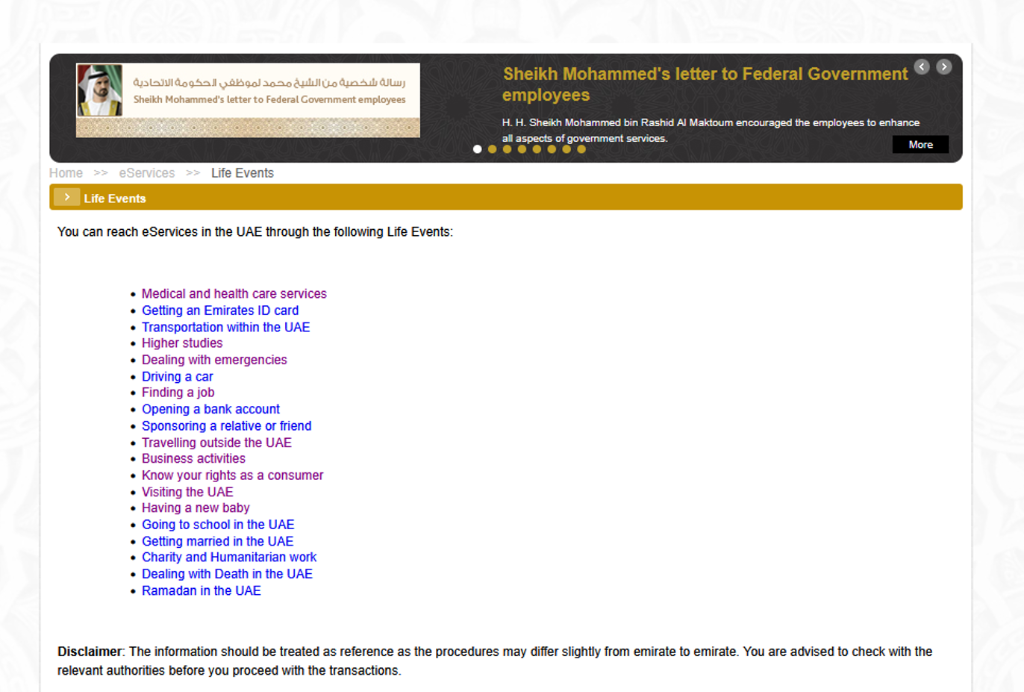
Considering the subsequent versions of the website which contain a 'Women' section, the 2020 version relied heavily on rankings, measurable achievements, and recognisable marks of progress, while the 2026 version is more service-oriented, policy-heavier, and future-facing. This shift is analytically significant because it suggests a move from visibly proving progress to normalising it: the state no longer merely presents women's advancements as evidence of change, but as an ordinary and integrated feature of governance.
5. Gender and Legitimacy: The 2020 Version of the Website
The 2020 version of the UAE government's 'Women' section illustrates how gender reform is transformed into a key component of digital legitimacy construction. Rather than functioning as a neutral informational space, the website organises women's rights through a highly structured catalogue of achievements, rankings, and state initiatives. In terms of the DHA, this reflects a combination of strategies of nomination and predication, whereby 'women' are discursively constructed as both a policy category and an object of state-furthered development. This produces what can be understood as a legibility regime, in which gender equality is rendered visible primarily through quantifiable indicators, institutional programmes, and internationally recognisable benchmarks.
A striking feature of the 2020 framing is its reliance on intertextuality and global comparison as a legitimising strategy. The section opens with references to the World Economic Forum's Global Gender Gap Report, highlighting high rankings in literacy, secondary education enrolment, and sex ratio at birth, as well as wage equality. Within DHA, these references operate as an argumentation strategy based on authority. These do not merely report progress; they anchor the UAE's gender narrative within global benchmarking systems. In doing so, the website translates complex and uneven social processes into simplified indicators of international competitiveness. As a result, gender equality is not primarily presented as a lived condition, but as a ranked achievement within global governance frameworks.
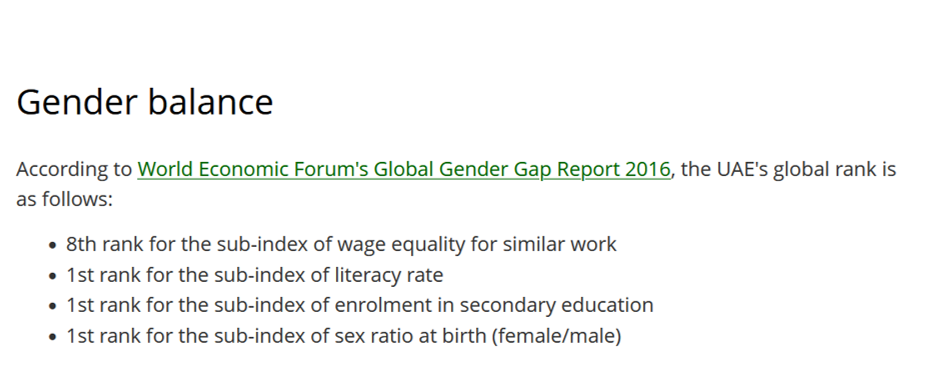
This emphasis on ranking becomes interesting when compared to the work of Sinha et al., where they state that the UAE consistently ranked at the bottom of international indices measuring gender equality and women's empowerment. The paper states that the UAE placed second to last in 2019 on the World Bank's 'Women, Business, and the Law' (WBL) Index with 29.38, thus implying that women had less than a third of the legal rights of men. Additionally, they mention that progress was lacking too according to World Bank 2019, while UAE ranked 120th out of 153 in the 2020 Global Gender Gap Index from the World Economic Forum in 2020. What is analytically significant here is the selective activation of intertextual sources, where only favourable external evaluations are incorporated into the rhetoric, whereas less favourable ones are excluded. What this implies is that the website, through its omissions of these rankings and others as such, placed emphasis on certain statistics which helped expand their legitimacy, while omitting other data that relates to women's rights in the UAE. The paper goes on to state that the UAE has been making progress since 2017 (e.g. compared to 2023, when the WBL index almost tripled) however, the omission is still relevant for the website, as it mirrors a logic of a specifically curated index-based legitimacy, selectively foregrounding the most favourable dimensions of gender equality, while omitting others.
Moving further, the 'Women' webpage is striking for another reason: UAE's population is made up of around 88 - 90% of foreign nationals, most of them coming from various countries in Asia, mostly India. Additionally, in the employed population in Dubai for example, the foreign nationals accounted for 96% of Dubai's employed population. Overall, UAE has historically been known as a state with a majority of expatriates, i.e. non-Emirati nationals. Even before UAE's formation, Dubai and Abu Dhabi outnumbered nationals. In this sense, it is striking to notice that the website primarily constructs its reference point through exclusion, indicating a restricted nomination strategy, whereby 'women' are implicitly equated with citizens rather than to the entire female population residing in the UAE.
At a closer discursive level, this idea becomes clearer. Under 'Gender balance', the hyperlinked text 'National Strategy for Empowerment of Emirati Women' reflects a clear nomination strategy anchored in national identity, where empowerment is closely tied to citizenship, thus migrant women remaining largely absent from the discourse. Moving further, under 'Social assistance', the text states:
The UAE recognises and values unpaid domestic work of women through the provision of public services, infrastructure and social protection policies and the promotion of shared responsibility within the household.
This functions as a predication strategy, attributing recognition and welfare-oriented characteristics to the state, thus building a benevolent institutional identity. However, the next paragraph explains that monthly allowances are offered to 'UAE nationals residing within the UAE', which introduces a contradiction between universalising language and exclusionary discourse, revealing a gap between surface-level inclusivity and underlying restrictions related to one's citizenship.
Further, another recognisable pattern emerges in texts' cohesion, e.g. in sections such as 'Women's Health'. Here, there is no mention of 'Emirati' or 'National' women, thus being discussed in generalised terms. However, the programme title, 'National Strategy for Empowerment of Emirati Women', reintroduces a restrictive nomination, indicating that the beneficiaries are Emirati women rather than women in general. The text reads:
To ensure universal access to sexual and reproductive health and reproductive rights as agreed in accordance with the Programme of Action of the International Conference on Population and Development and the Beijing Platform for Action, the National Strategy for Empowerment of Emirati Women aims at providing healthcare services to woman in order to enhance her body and psychological health. The strategy provided mechanisms to achieve this goal:
1.obtaining healthcare services to enhance woman health;
2.Giving more attention to healthcare needs of women in remote areas;
3.enhancing health awareness programs for women in different ages and all over the UAE;
4.establishing mechanisms and programs to enhance psychological health of women in all ages;
Read more about the women's healthcare in the UAE.
In this text, the DHA readings highlight a shift between universalising discourse ('women') and restricted nomination ('Emirati women'), producing a strategic ambiguity in framing.
Additionally, another pattern is discernible - hyperlinked information redirects the users to Emirates News Agency's official website, which is UAE's official state-controlled news outlet, thereby replacing external validation by intra-state circulation of information. In this case, the hyperlink leads to a brief announcement of the launch for the National Strategy for Empowerment of Emirati Women. However, the article succinctly describes the programme, without offering additional information on implementation, mechanisms or evaluations. Consequently, this is a brief elaboration, whereby policy is presented as declarative rather than procedurally explained.
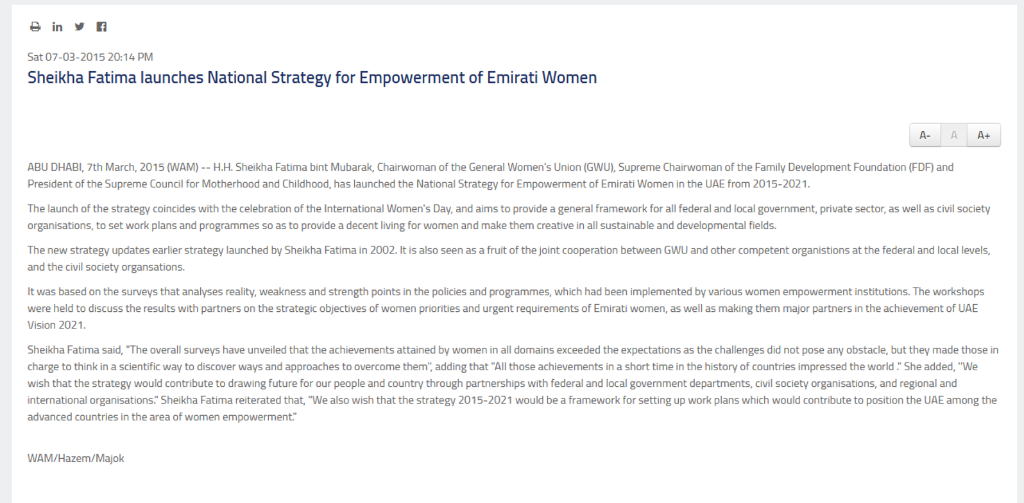
Overall, the 2020 webpage constructs women's empowerment through a set of interrelated DHA strategies: nomination through citizenship-based categorisation, predication, and argumentation through authoritative indices and state-controlled intertextual sources. Additionally, this structure is simultaneously characterised by systematic omission, in particular regarding migrant women and structural inequalities that are not portrayed within global benchmarking frameworks. The result is a discourse of gender equality that is highly legible within governance regimes, but which abstracts from the uneven social realities it declares to represent.
6. Gender and Legitimacy: The 2026 Version of the Website
The 2026 version of the UAE government's 'Women' section reflects a notable transformation in how gender equality is digitally constructed. Compared to earlier iterations that emphasised international rankings and benchmarking, the 2026 page reframes women's empowerment through the language of services, infrastructure, and administrative provision. In terms of DHA, this signals a shift in argumentation strategy, moving from a topos of comparison (international ranking and competitiveness) towards normalisation, where gender equality is presented as an already highly institutionalised and self-evident feature of governance.
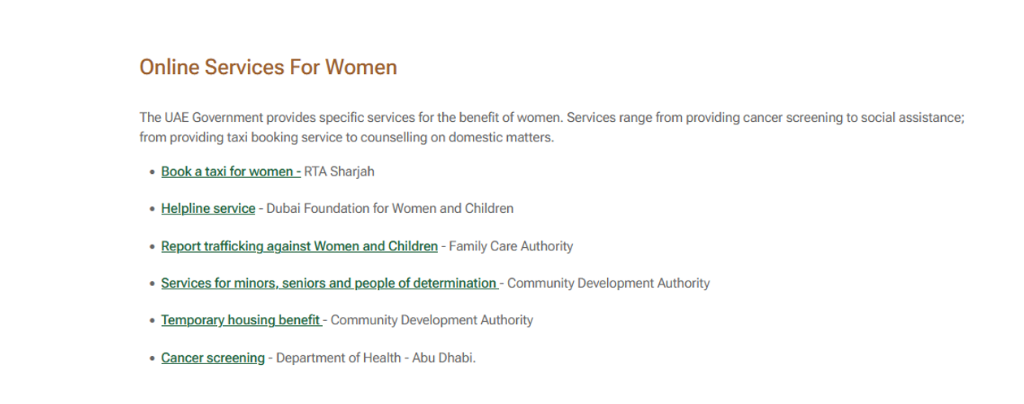
The structure of the page is no longer centred on demonstrating achievement through global indices. Instead, it organises information around functional categories such as online services, health, education, housing, transport, and social assistance. Gender equality is no longer presented as something that must be proven internationally, rather it is presented as something already embedded in the everyday functioning of governance systems. This is evident in the repeated emphasis on service delivery mechanisms such as helplines, housing benefits, counselling services, and healthcare. More specifically, the page opens with a hyperlinked service portal rather than ranking-based indicators as in the 2020 version, further reflecting a shift in discourse.
Additionally, there is a noticeable shift in nomination - while the earlier version frequently foregrounded 'Emirati women' as an explicit referent category, the 2026 version more frequently uses the broader term 'women', suggesting a discursive move towards universalisation. However, this apparent inclusion is undermined, as eligibility is often restricted to national individuals, but the information is embedded in linked sub-pages, instead of in the main text body. To give a clear example, the former programme 'National Strategy for Empowerment of Emirati Women' in 2020 becomes the 'National Policy for Improving Women's Health' in 2026. This reflects a shift in nomination strategies from identity-related framing ('Emirati women') to universalised framing ('Women'), while nonetheless maintaining institutional selectivity at the level of access to these services.
The emphasis on service provision also subtly reshapes the argumentation structure of empowerment. For example, references to transport safety measures (women-only taxis, reserved seating, designated parking) and social protection schemes (housing allowances, temporary housing benefits, counselling services) construct women as a category requiring targeted facilitation. While these provisions can be read as forms of welfare expansion, they also reproduce a paternalistic rhetoric in which gender equality is articulated through managed protection rather than structural transformation.
At the same time, however, the website employs a discursive practice of referring to 'women' in general terms on the main webpage, while simultaneously directing users through hyperlinks to services that are primarily restricted to UAE nationals on sub-pages. For example, on the 2020 version, the 'Housing' section states:
Sheikh Zayed Housing Programme provides housing for single Emirati women.
On the other hand, the 2026 version states:
Ministry of Community Empowerment provides housing allowance to women. Read about it under social welfare programmes. In addition, Ministry of Energy and Infrastructure provides housing aid. Read about it under housing authorities and programmes.
While the 2026 version seems to be addressing women in general, including non-national women, the hyperlinked pages redirect users, in practice, to services that are almost exclusively restricted to UAE citizens. As a result, the main page obscures the continued predominance of citizen-based eligibility, thus constructing an impression of greater inclusivity towards migrant women than is reflected in the underlying service structure.
At the same time, the 2026 section continues to reproduce a highly state-centred definition of empowerment. Women's inclusion is consistently mediated through government institutions such as ministries, authorities, and federal programmes. Even initiatives that appear to expand autonomy, such as digital skills training or cybersecurity programmes for women (which were not present on the 2020 version), are embedded within state-led frameworks like the General Women's Union and the Cyber Security Council. This reinforces the argument that empowerment is not framed as an autonomous social process, but as something enabled, structured, and validated by the state.
Overall, the 2026 version constructs women's empowerment through a revised set of strategies: from nomination through citizenship-specific categorisation to partial universalisation, from international benchmarking to institutional normalisation. However, the updated rhetoric does not eliminate underlying limitations. Instead, it displays them through more subtle forms of embedding, where inequalities are less visible not because they do not exist anymore, but because they are relocated into hyperlinked structures which are not immediately visible, unless users choose to navigate to those sub-pages.
7. Post-2017 Reform and the Transformation of Digital Legitimacy
Taken together, the shift from the 2020 to the 2026 version of the 'Women' section reflects a broader post-2017 trajectory in which legal reform is progressively absorbed into the UAE's digital governance architecture and re-expressed in different forms of legitimacy. The reform wave identified by Sinha et al. after 2017 produced a dense set of legal and institutional changes that significantly improved the UAE's position within global gender equality indices. In the earlier phase, this translated into a digital emphasis on visibility, comparison, and ranking-based legitimacy, where progress needed to be actively demonstrated through international benchmarks such as the Global Gender Gap Report. However, once these reforms had been stabilised within global datasets and reputational frameworks, the communicative logic of the website shifts. The 2026 version no longer relies on external comparison as its primary justification, but instead embeds gender equality within the routine language of services, infrastructure, and administrative provision. This move from visibility to normalisation reflects a deeper transformation in how reform is governed digitally: what once had to be proven as evidence of progress is now presented as an already operational feature of the state. At the same time, across both versions, the structural tensions identified in the literature - particularly the uneven translation of legal reform into de facto reality and the continued exclusion of migrant women - remain largely absent from the official narrative. In this sense, the evolution of the website does not simply track policy change, but reveals how post-2017 reforms are continuously re-mediated into forms of digital legitimacy that shift from international performance to administrative naturalisation, while maintaining selective silences about underlying inequalities.
8. Conclusion
This essay shows that UAE's official government website functions not simply as an informational infrastructure, but as a curated space through which the state aims to construct legitimacy, modernity and geopolitical credibility. Through selective framings, rankings, policy language, the website translates complex and uneven legal change into a coherent narrative of national progress. The comparison between the 2020 and 2026 versions of the 'Women' section shows a broader shift in UAE's post-2017 governance trajectory. While the earlier version relied predominantly on international benchmarking to demonstrate progress, the 2026 version tried to normalise gender equality through the inclusion and language of services, welfare provision, and bureaucratic infrastructure. This shift from visibility to normalisation reflects a transformation in how legitimacy is digitally displayed and maintained.
At the same time, this analysis has shown that the digital representations of women's empowerment depend upon selective inclusion and omission. Structural inequalities, in particular with regards to migrant women and the uneven relationship between formal legal transformations and de facto reality remain far less visible within official narratives. The UAE's government website therefore operates not only as tools of communication, but also as mediums through which reform is narrated and made internationally legible.
Bibliography
- Ali, Syed, Dubai: Gilded Cage (Yale University Press, 2010)
- Androutsopoulos, Jannis, 'Potentials and Limitations of Discourse-Centred Online Ethnography', Language@Internet, 5 (2008), 1-20 <https://scholarworks.iu.edu/journals/index.php/li/article/view/37571>
- Arora, Sanjay; Li, Yin; Youtie, Jan; Shapira, Philip, 'Using the wayback machine to mine websites in the social sciences: A methodological resource', Journal of the Association for Information Science and Technology, 67.8 (2015), 1904-1915 <https://doi.org/10.1002/asi.23503>
- Barnwell, Kristi, 'Security for the UAE', in The Formation of the UAE: State-Building and Arab Nationalism in the Middle East (London: I.B. Tauris, 2024), pp. 153-174 <http://dx.doi.org/10.5040/9781838605308.ch-007>
- De Bel-Air, Fran-oise, 'Demography, migration, and the labour market in the UAE', Migration Policy Centre, 7 (2015), 3-22 <https://hdl.handle.net/1814/36375>
- Herring, Susan, 'Computer-Mediated Discourse Analysis: An Approach to Researching Online Behavior', School of Library and Information Science (Indiana University) <https://homes.luddy.indiana.edu/herring/cmda.pdf>
- KhosraviNik, Majid, 'Critical Discourse Analysis, Power, and New Media (Digital) Discourse', in Why Discourse Matters: Negotiating Identity in the Mediatized World (New York: Peter Lang, 2014), pp. 287-306
- Murphy, Jamie; Hashim, Noor Hazarina; O'Connor, Peter, 'Take Me Back: Validating the Wayback Machine', Journal of Computer-Mediated Communication, 13.1 (2007), 60-75 <https://doi.org/10.1111/j.1083-6101.2007.00386.x>
- Pinto, V-nia Carvalho, 'Signalling for Status: UAE and Women's Rights', Contexto Internacional, 41.2 (2019), 345-364 <http://dx.doi.org/10.1590/S0102-8529.2019410200006>
- Reisigl, Martin; Wodak, Ruth, 'The Discourse-Historical Approach (DHA)' in The Routledge Handbook of Critical Discourse Studies (2017) <ResearchGate>
- Saeed, Reem, 'Human Rights Reform in the UAE: Natural Socio-Political Evolution or Positional Strategy?', E-International Relations (2021), 1-6 <https://www.e-ir.info/pdf/94974>
- Sinha, Ranjana; Lehmann, Karolin; Djankov, Simeon, 'The Sudden Surge in Gender Legal Reform in the UAE', Discussion Paper, 889, 1-17 <https://www.fmg.ac.uk/sites/default/files/2023-10/DP889.pdf.pdf>
- 'UAE enacts largest legal reform in its 50-year history' (2021), The National News <The National News>
- Emirates News Agency <https://www.wam.ae/en/home/main>
- Wayback Machine <https://web.archive.org/>