How medical authority sought to legitimise sterilisation, `euthanasia` and genocide: An insight into eugenics and its representations
In what ways did eugenic science and medical authority seek to legitimise Nazi policies of sterilisation, 'euthanasia', and genocide, and how have these issues been represented at the Imperial War Museum in London and in the US Holocaust Memorial Museum's online exhibition?
1. Introduction
Eugenic science and medicine played a significant role in making the Nazi policies of sterilisation, 'euthanasia' and genocide appear not as monstrous acts of violence, but as rational and scientifically grounded interventions intended to maintain and promote the health of the national community. Yet contemporary museums do not simply tell the history - they actively shape how visitors understand the relationships between medicine, science, violence and murder. The form through which this history is encountered - spatially within a museum gallery or digitally on a website - also shapes how the public interprets the history. This essay argues that eugenic science and medical authority tried to legitimise sterilisation, 'euthanasia' and genocide by presenting racial violence as rational public health policy, and that contemporary Holocaust exhibitions represent this differently. At the Imperial War Museum's Holocaust Galleries in London, eugenics is made structurally visible through installations which spatially embed eugenics within a chronological and immersive narrative of escalating violence. By contrast, the United States Holocaust Memorial Museum's online exhibition distributes this history across hyperlinked structures that prioritise accessibility, user-directed navigation and informational depth over embodied immersion.
2. Methodology
Methodologically, this essay employs a comparative analytical framework tailored to the differing exhibition forms. Because the physical exhibition at the Imperial War Museum and the online exhibition at the US Holocaust Memorial Museum operate through fundamentally different media - one spatial and embodied, the other digital and hyperlinked - the representation of eugenics and medical authority is shaped not only by curatorial interpretation, but also by structures through which visitors encounter information. Consequently, rather than applying a single pre-existing model, this framework draws on approaches from museum studies and digital heritage analysis to explore three key dimensions: navigation and physical/ interface design, curatorial framing and medical legitimacy and representations of perpetrators. Additionally, for simplicity and clarity, the Imperial War Museum and the United States Holocaust Memorial Museum will hereafter be referred to as IWM, and USHMM respectively.
3. Historical Context: Eugenics and Medical Authority
To properly understand how the IWM and the USHMM represent eugenics and medical authority, it is necessary to situate these within the broader epistemic history that rendered them plausible as forms of scientific expertise. Nazi sterilisation policies, and genocide did not arise arbitrarily, but from an international scientific culture in which heredity, population, and value were increasingly rendered quantifiable.
This epistemic shift is usually associated with Francis Galton's Hereditary Genius (1869), which endeavours to demonstrate that intellectual and moral capacities are inherited traits distributed along family circles. Galton's claim that 'it would be quite practicable to produce a highly-gifted race of men [...]' is not simply a policy suggestion, but an epistemological assertion: it assumes that social hierarchy can be translated into biological data. His analysis of eminent kinship networks (Table II below) presents 'eminence' as evidence of hereditary transmissions over generations and within family lines, but this method depends on a concealed circularity (social prestige and class are used as proof of biological superiority, and biological superiority is then used to explain the initial prestige). What appears as empirical observation is therefore already structured by assumptions about worth and value.
By the early twentieth century, this framework has spread transnationally, not as a unified doctrine, but rather as a flexible scientific language adaptable to different national ideas about modernity, and social order. In this sense, an example is Friedrich Wilhelm Schallmayer, Germany's first advocate of eugenics. He published the first German Eugenics Treatie, Über die drohende körperliche Entartung der Kulturmenschheit und die Verstaatlichung des ärztlichen Standes. Although Schallmayer claimed he read neither Galton nor the passage in Charles Darwin' Descent of Man which tackles similar ideas, scholarly literature hints that he might have at least been influenced by ideas 'in the air' at the time. Through this, Schallmayer rearticulated eugenic ideas through the language of 'Rassenhygiene' by embedding hereditarian thinking with national concerns about vitality and biological decline.
The significance of this international field is that it normalised eugenics as a form of scientific common sense across the medical domain, law, and public administration. By the interwar period, eugenic rationale had become institutionalised within psychiatric classification systems, sterilisation laws, and various public health regulations in multiple countries (e.g. Sweden, Austria, Estonia in Europe, USA and Canada in America, Japan in Asia). This institutional embedding is crucial - it meant that when the Nazis radicalised these ideas, they did so through existing categories of medical and administrative legitimacy, rather than creating an entirely new epistemology (e.g. Canton of Vaud in Switzerland was the first European entity to introduce a law on compulsory sterilisation in 1928).
Within Nazi governance, medical authority functioned not simply as a scientific foundation, but also as a mechanism of translation between ideology and practice. Physicians and scientists formulated ideological categories - such as 'life unworthy of life', or 'hereditary illness' - into clinical categories that could be operationalised within administrative systems (from Binding and Hoche's Die Freigabe der Vernichtung lebensunwerten Lebens, 1920, respectively, from the Gesetz zur Verhütung erbkranken Nachwuchses, 1933). The 'euthanasia' programme is particularly significant, because it demonstrates how killing could be reframed as treatment through the language of racial hygiene, allowing physicians to present the killing of disabled patients as a form of medical decision-making, while these killings were simultaneously concealed from families through falsified diagnoses such as pneumonia. In this sense, medicine attempts not only to legitimise violence retrospectively, but actively designs the forms under which violence becomes thinkable as rational intervention.
This history is directly relevant to the curatorial choices of both exhibitions. The IWM embeds eugenics within a continuous, spatial narrative of escalation, where medical authority is presented as the starting point of a trajectory towards genocide. Conversely, the USHMM disperses eugenics across a hyperlinked structure in which its significance is retained but made optional through users' choice. What emerges are two different ways of presenting historical causation: one grounded in embodied, sequential inevitability, and the other in distributed knowledge.
4. Introduction to first case study - Holocaust Galleries at Imperial War Museum
As the first case study, the IWM's Holocaust Galleries will be analysed, as well as the ways in which the physical design, interpretive texts and overall curatorial choices construct eugenics and medical science within the wider framework of Nazi terror. The Holocaust Galleries offer extensive information on a wide range of themes and ideas around the Holocaust. As some scholars might argue, it could potentially be said that it even offers too much detail within the exhibition. Consequently, certain aspects of the exhibition may be overlooked by visitors who spend less time in the gallery (such as the Speedy Samplers put forward by Muggleton, Monteath and Yasseri), a factor that becomes particularly relevant when compared with the more selective and digitally structured display of the USHMM's website.
4.1. Physical design
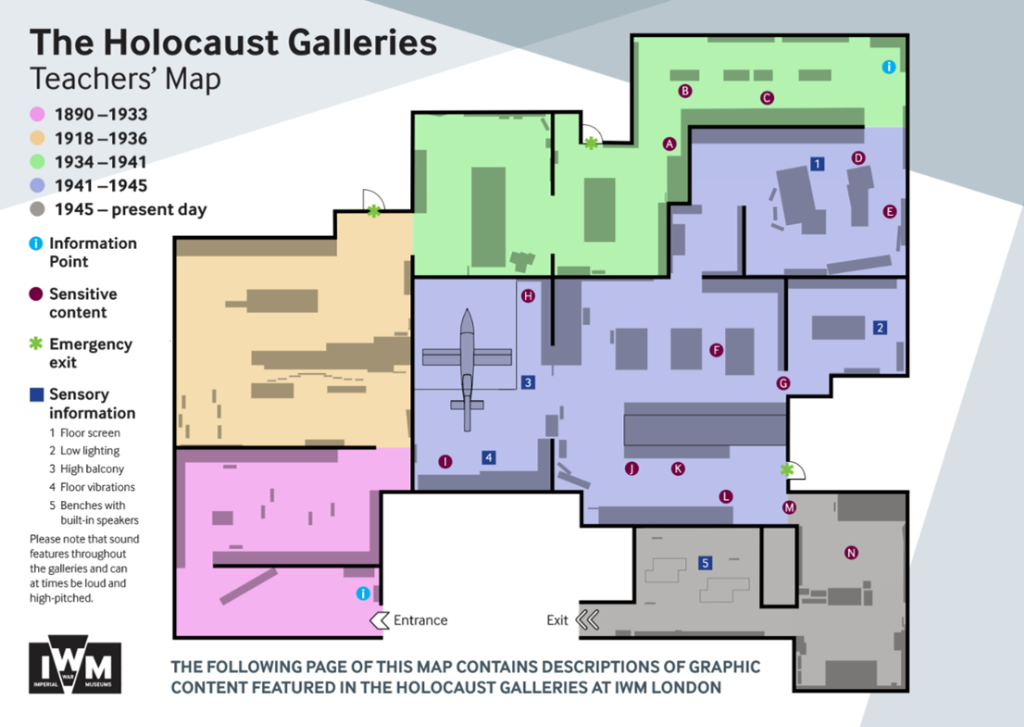
IWM constructs their representation of the Holocaust chronologically. The visitors are firstly introduced to the idea of medicine and science in the second half (upper half) of the orange area. Moving forward, the 'euthanasia' programme sits in the third section of the green area, while the purple area encompasses the final solution. Thus, it invites visitors to understand the Holocaust atrocities not as a sudden event, but rather as a gradual, structured progression from the scientific foundation to systematic mass murder. The gallery's spatial organisation therefore constructs eugenics not as a marginal precursor to Nazi terrors, but as a central stage within an escalating process of exclusion and extermination.
Looking at the placement of medicine-related content within the rooms, it is worth noting that in the case of the first and second sections (eugenics with its theoretical foundations and 'euthanasia' programme), they are placed in the middle of the section and are the first thing one sees when entering those certain areas. In this sense, a recent study of visitor behaviour at British Museum uses audio-guide logs and spatial flow modelling to show how room popularity and visitor paths are primarily driven by physical accessibility and proximity, rather than by curatorial choices. By locating the medicine installations in the middle of the respective rooms, IWM effectively maximises the likelihood that visitors will come across racial science even if they follow the easiest, most obvious route.
4.2. Curatorial framing and medical legitimacy
Upon entering the section, visitors are introduced to the foundations of eugenics and medical science. The panel A New Order explains how the Nazis tried to radically reshape Germany around a single community (Aryans) defined by beliefs, behaviour and biology. The poster for Francis Galton's Anthropometric Laboratory, accompanied by the interpretive text highlighting his status as a British eugenicist who pioneered the use of statistics for studying inherited characteristics across generations, situates eugenics within mainstream, international science. A noteworthy object is a poster with a tree diagram, explaining how eugenics drew authority from many prominent fields, such as genetics, anthropology, law, statistics, geography, medicine, religion. This inclusion of areas, some non-scientific, shows that eugenics was presented not only as a biological science, but also has a comprehensive way of understanding and explaining the society and human condition, thus drawing legitimacy from a moral, cultural, historical and medical perspective, presenting eugenics as a totalising framework. This collection of objects invites the visitors to see Nazi racial policy not as an aberration, but as an extreme and well-planned development within a broader international culture that viewed heredity and society improvement as legitimate scientific matters.
Moving forward, IWM links eugenics into Medicine and mass murder, and then later the in the Final Solution section, making the continuity between sterilisation, euthanasia and genocide clear and situating it chronologically within the bigger frame of the Holocaust. Panels on the T4 programme includes material on doctors such as Karl Brandt and show deceptive letters sent to families where the killing of disabled patients was presented as a medicalised, authorised process, administered by professionals, continued then later in the wall of names in the Killing center room, where visitors get to understand that many of the Nazis had worked in the T4 programme before being transferred to the death camps. Thus, rather than presenting genocide as a sudden measure, the exhibition frames it as a culmination of increasingly radical forms of medically and administratively legitimised violence. Therefore, the IWM exhibition powerfully shows that the Holocaust was not merely a product of abhorrent Nazi ideology, but rather a movement that claimed to act in the benefit of society.
4.3. Representation of perpetrators
A notable aspect of IWM's Gallery is its representation of perpetrators. Throughout the gallery, significant emphasis is placed on the prominent Nazi figures (Hitler, Goebbels, and, generally, people in positions of authority; another example is Robert Ritter who was appointed director of the Ministry of Health's Research Unit for Racial Hygiene and Population Biology, or Karl Brandt, as co-director of the 'euthanasia' programme). What this does is place the responsibility on people in charge: top Nazi officials and extreme ideologists. This approach risks underrepresenting how ordinary people, not related to the SS in any way, took part in the atrocities. This claim is supported by various scholars, including Lawson, who states that by animating the Nazi victims (offering biographical information, pictures), the visitor is encouraged to identify with the victims and empathise. However, when talking about perpetrators, the focus is placed on top Nazi officials. Lawson claims, therefore, that the representation fails to show how ordinary people can be involved too: The perpetrators remain comfortingly alien, but if they had been shown to have existed outside of the SS and independent of an ideological mania, [...], then perhaps the visitor would have been confronted with the much more challenging reality that it is possible to identify with a killer too. By foregrounding elite perpetrators while marginalising broader social complicity, the exhibition risks presenting medical terror as the product of exceptionally extremist ideological ideas rather than a process in which ordinary participation took place.
5. Introduction to second case study - United States Holocaust Memorial Museum (online)
As the second case study, the USHMM's online presence will be analysed, alongside how its digital design, interactive elements and curatorial choices portray eugenics and medicine within the broader context of Nazi ideology. Unlike the immersive and spatially controlled environment of the IWM gallery, USHMM's website operates through modular navigation which encourages self-directed exploration.
5.1. Navigation & interface design
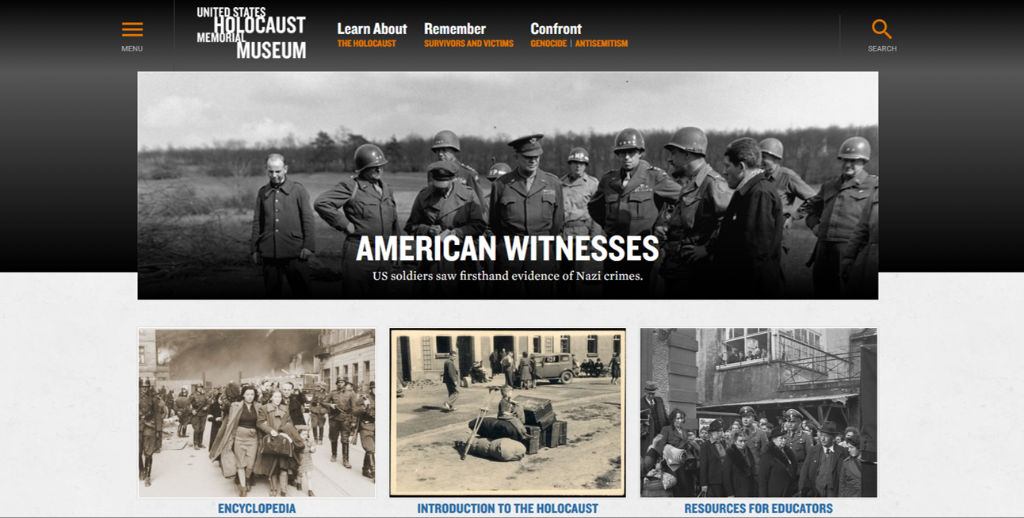
USHMM's main webpage offers visitors three main directions: Encyclopedia, Introduction to the Holocaust and Resources for Educators. Relevant is the Introduction to the Holocaust webpage, which is structured as a pedagogical, question-and-answer story designed for first-time learners of the Holocaust - it begins by defining the Holocaust, then moves forward to causes, escalation and methods in a linear scroll, accompanied by images, maps and media boxes. USHMM foregrounds antisemitism through a comprehensive genealogy that includes the Christian religious prejudice towards Jews, all the way to the racial and economic antisemitism. Eugenics itself appears only briefly in a single sentence that groups theories of race, eugenics and Social Darwinism together as concepts that falsely justified hatred towards Jews.
The main webpage therefore keeps eugenics and medicine largely as additional information, but it does so while pointing interested viewers towards more specialised resources. The word eugenics itself is hyperlinked to a separate Holocaust Encyclopedia entry where more information is provided. That is to say, the work that IWM performs in its initial eugenics section - highly visible upon entering the room - is present on the USHMM website but placed into a lateral encyclopedic sub-webpage aimed at users who choose to follow through, rather than being built into the introduction that most visitors will read through.
5.2. Curatorial framing and medical authority
On the introductory page of the USHMM's website, responsibility for the implementation of Nazi policies is distributed across a broader range of societal actors - soldiers, lawyers, businessmen - with doctors and nurses mentioned only briefly, embedding medicine within the wide professional complicity rather than highlighting its distinct epistemic authority. This risks flattening medicine's specific power to define normality and heredity into a nationwide narrative of bureaucratic and medical participation. While the IWM galleries place medicine as a central stage in the escalation towards genocide, the USHMM website integrates doctors and medical professionals into a broader framework of institutional complicity. Consequently, medicine at USHMM appears less as a distinct epistemic authority and more as one component within a wider network.
This becomes more complex on the Eugenics page, where Charles Davenport is mentioned, which signals that US biologists were involved in these movements as well, not only German scientists. While the USHMM primarily frames eugenic science through the context of Nazi Germany, the inclusion of Davenport also functions to acknowledge American participation in the broader eugenic movement. This contrasts with the IWM exhibition, which distributes responsibility more widely across Europe and the US as part of a transnational scientific culture that promoted hereditarian thinking.
5.3. Representation of perpetrators
USHMM's representation of perpetrators is more obvious than at IWM. Rather than focusing primarily on a small number of top Nazi leaders or medical experts, the website explicitly extends responsibility beyond the German state to include ordinary Germans, collaborators, institutions, bystanders across Europe. With this, it presents the Holocaust as a collective process of complicity and indifference, rather than as the work of a limited number of perpetrators. This is particularly visible in the way the website describes ordinary German people. The material states that they participated in the Holocaust by cheering on the humiliation of Jewish people, denouncing them, or just by remaining indifferent to their persecution. Their motives (enthusiasm, careerism, fear, greed, self-interest, antisemitism, and political ideals) are varied and recognisably human, thereby pinpointing perpetration within ordinary social behaviour rather than isolated, extremist ideological fanaticism. USHMM, therefore, signals that the guilt doesn't rest only with top Nazi officials. In contrast to the IWM galleries, where the density of the material (as emphasized by Lawson) and emphasis on elite Nazi figures can make broader participation less immediately visible, the USHMM website foregrounds the role of ordinary individuals more explicitly. Its clear and selective structure enables perpetrator complicity to emerge as a central explanatory framework rather than a secondary layer.
6. Comparative Analysis
Ultimately, the comparison between IWM and USHMM reveals two different ways of representing the relationship between eugenics, medicine, and genocide. IWM's physical galleries construct a chronological and spatial narrative in which the public encounters these as stages within an escalating continuum of violence. Through object placement and movement through the exhibition, medical authority becomes embedded within the progression towards genocide. By contrast, USHMM's online display decentralises this route through hyperlinked and user-directed navigation. Eugenics remains present, but its significance depends on whether the audience chooses to explore additional material. Consequently, IWM foregrounds immersive continuity and escalation, while USHMM prioritises modular learning, but also broader societal complicity. These differences show how exhibition form itself shapes historical interpretations and public understanding of mass violence.
7. Conclusion
To sum up, eugenics and medical authority were central to Nazi's attempt to legitimise sterilisation, 'euthanasia', and genocide by framing racial ideology as medical knowledge, where concepts such as heredity and 'life unworthy of life' made violence appear scientifically necessary rather than ideological. Importantly, the comparison demonstrates that this representation is not only historical, but also epistemic: it depends on how knowledge itself is organised by the curators and encountered by the public. Therefore, curatorial choices - including whether history is encountered physically or digitally - can fundamentally shape how the public perceive causation, responsibility, and the relationship between science and mass violence.
Bibliography
- Amy, Jean-Jacques Amy and Rowlands, Sam, 'Legalised non-consensual sterilisation - eugenics put into practice before 1945, and the aftermath. Part 2: Europe', The European Journal of Contraception and Reproductive Health Care, 23.3 (2018), 194-200.
- Galton, Francis, Hereditary Genius (London: Macmillan and Co., 1869).
- Lawson, Tom, 'Ideology in a Museum of Memory: A Review of the Holocaust Exhibition at the Imperial War Museum', Totalitarian Movements and Political Religions, 4.2 (2003), 173-183.
- Weiss, Sheila Faith, Race Hygiene and National Efficiency: The Eugenics of Wilhelm Schallmayer (University of California Press, 1987).
- Muggleton, Naomi; Monteath, Timothy; Yasseri, Taha, Beyond Demographics: Behavioural Segmentation and Spatial Analytics to Enhance Visitor Experience at The British Museum (arXiv preprint arXiv:2510.27542, 2025).