The construction of the adversary: Ideological architecture in totalitarian media systems
How did Nazi propaganda attempt to construct the enemy in World War II?
While 'propaganda is ethically neutral - it may be good or bad', but a communicative technique that can serve a wide range of political perspectives, as Welch emphasizes, its use in Nazi Germany demonstrates how such techniques can be used to construct a radicalised enemy image that prepares the ground for exclusion and violence. Being a complex process that required multiple stakeholders, the propaganda during National Socialism was present in all aspects of life, including the arts (music, architecture, poetry), in the media (through radio, newspapers, posters, cinema), but also in day-to-day activities of the citizens, including in women's ways to cook, or even wash laundry. This essay looks at how during Nazi Germany, the image of the enemy was translated into concrete propaganda practice by focusing on caricatures and children's books and argues that the specific formal properties of these media were crucial in making the figure of the enemy appear immediate, threatening and emotionally compelling to ordinary Germans.
Precisely because propaganda operated across so many areas of everyday life, it cannot be adequately described in simple, one-dimensional terms. The very understanding of the word 'enemy' opens the door to interpretations, as the propaganda did not simply depict the military opponents such as the United Kingdom, the United States, or the Soviet Union as enemies, but it constructed a much broader, racially-driven, ideological world enemy that supposedly threatened Germany in the past, and still did at that moment and would continue to in the future. At the centre of this image stand the Jews, sometimes fused with Bolshevism and the Western states, sometimes also with disabled people or the Roma community, so that the military war could be reframed as a defensive struggle of the Volksgemeinschaft against an existential, dangerous enemy. A common practice of Nazi officials was to associate Jews with negative events, such as with Germany's loss during World War I, a core characteristic of the propaganda which set the foundations for the violence and terror that took place later on, or the subsequent Treaty of Versailles which was orchestrated by Britain, France and the United States. Therefore, although the Jews did not constitute a sovereign state fighting Germany in a war, Nazi propaganda constructed them as the primary enemy by redefining warfare as a racial and ideological struggle, in which the Jews were shown as a global, conspiratorial force responsible for both internal misery and decay and external military opposition.
The construction of the enemy in Nazi propaganda was closely intertwined with the glorification and deification of Adolf Hitler and the praising of the people - the Führer's image, together with that of Aryans, and that of the enemy were constructed in a fundamentally relational manner and the distinction between the two was very clear ('In the first case we have the Aryan States, based on the principles of work and cultural development'). Kohl speaks of the 'Self' and 'Other' in Nazi propaganda, where the distinction between them seemed to be equal to the distinction between good and evil: Aryans were made synonymous with everything that is good, and the Jews with everything that is bad: 'Every manifestation of human culture, every product of art, science and technical skill, which we see before our eyes to-day, is almost exclusively the product of the Aryan creative power. This very fact fully justifies the conclusion that it was the Aryan alone who founded a superior type of humanity' and 'they have [...] ruined the Jew in their urge to protect themselves against what they consider to be a scourge of God.' This binary relationship of a good Aryan and the demonic Jewish provided the ideological template that visual, auditory, narrative propaganda then translated into concrete enemy images for mass audiences.
1. Antisemitic Caricatures: Making the Enemy Visible
If the ideological contrast between the virtuous 'Self' and the demonic 'Other' formed the conceptual core of the construction of the Nazis' enemy, antisemitic caricatures were among the most prolific media through which this binary relationship was made visible in everyday life. Circulating in newspapers, on street walls, in exhibitions, these images concentrated complex racial stereotypes into easily recognizable visual means that taught viewers how to identify the enemy. The following section examines how caricatures portrayed the Jews through recurring motifs including physical distortion, dirt, greed, conspiracy, and how these techniques made the notion of the Jewish world enemy appear concrete to the German population.
This idea becomes particularly clear in the cover photograph of a magazine originally distributed in German, then among German American Bund members in the United States - Die Juden in USA by Hans Diebow. The cover photograph shows a Jewish man dressed in a dark suit with a white shirt, seated on the grass in a rather disgraceful pose, while eating greedily from an abundant plate of food with meat, with his hand bringing the food to his mouth; above stands the caption 'Die Juden in USA'. The picture invites the viewer to view the Jew with disdain, combining bourgeois clothing with undignifying body language, so that the man appears both wealthy and uncultured, unmannered - a visual image of the stereotype of the Jewish opportunist who enjoys plenty while others are struggling and sacrificing. Simultaneously, the title explicitly ties 'Die Juden' with the military enemy - the United States, implying the idea that a racialised Jewish persona stands behind one of Germany's main enemies during war, or that at least this Jewish persona 'sided with the enemy', as Narayanaswami puts it.
What is also striking about the caption is that it is consistent with Hitler's idea of how propaganda should be constructed ('All propaganda must be presented in a popular form and must fix its intellectual level so as not to be above the heads of the least intellectual of those to whom it is directed'), which in this case can be seen because the caption is itself short, clear and simple. Looking at the rest of the text on the photograph, 'Über 100 Bilddokumente' seems to claim objectivity, as if the photograph shows facts, even though the cover reveals a rather stereotypical framing. Hence the enemy is portrayed through selective, staged images presented as natural, realistic, documentary-like evidence. Also important in terms of wording, the imprint 'Zentralverlag der NSDAP, Franz Eher Nachf.' highlights the idea that this is an official communication from the party, thus being state-endorsed.
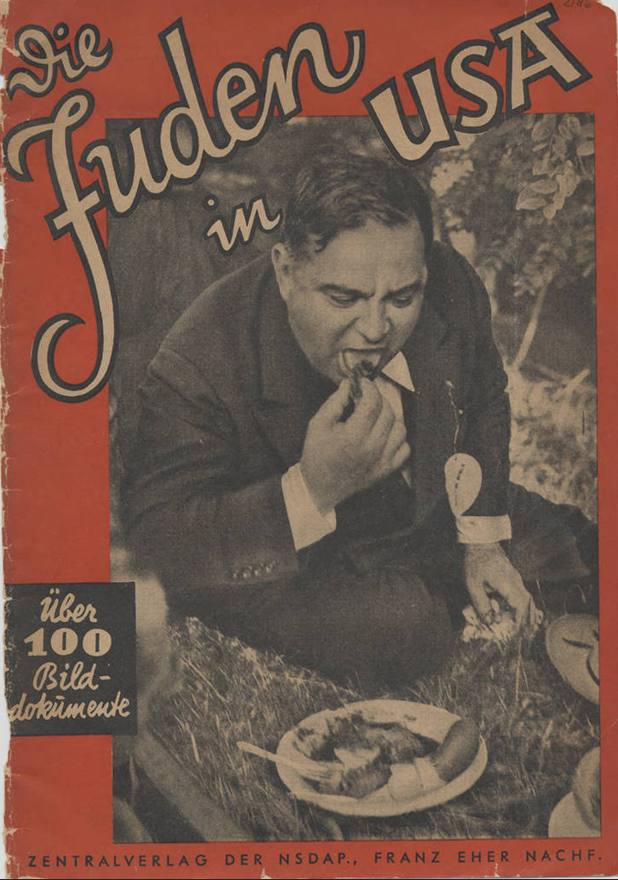
This visualisation aligns with common patterns in antisemitic imagery, where Jews are either depicted as physically degenerate, parasitic figures or as fat, greedy collaborators or supporters of the military enemy, a selective focus on 'unpleasant' features that creates a biased and homogenous imagery. Observed through the lens of psychological concepts such as 'negativity bias' and 'clustering illusion', the continuous exposure of Germans to such visual elements conditions them to associate the Jewish people with ugliness, greed, conspiracy, while the idealised, superior portrayals of Aryans reinforce a sense of supremacy. With this, a single cover photograph already shows how Nazi propaganda used visual simplification and easy wording to embed the idea of the Jew as a dangerous, foreign-allied enemy into German's everyday perception.
A second example which illustrates this idea is the poster Hinter den Feindmächten: der Jude from 1942. In the image, a dark male figure dressed in a black suit with a white shirt, bow and hat stands behind three large flags - the United States, United Kingdom and Soviet Union flags, having a clear mark of his race - the Star of David. The caption on the photograph states the thesis openly, using, again, clear, simple words: 'Behind the enemy powers: the Jew'. The body's figure is divided by the vertical stripes of the US flag in the middle, the Union Jack on the left and the Soviet flag on the right, so that the three powers appear as a foreground masking a single, hidden agent that is in the background: the Jew. The Jewish symbol is the only detail on an otherwise shadowy body, functioning as a label that reduces the person to their main characteristic - being a Jew, while the absence of other features turns him into an anonymous type, a diffuse conspiratorial force rather than an individual acting behind the scenes - it is the entire Jewish community that is portrayed in the image.
Therefore, the poster succeeds in visually fusing Germany's military enemies - UK, USA and Soviet Union - with the racial enemy at the core of the National Socialist ideology by placing the Jewish protagonist as their common denominator, mirroring the broad propaganda idea that the Jews choreograph both Western plutocracy and Soviet Bolshevism. Using flat blocks of colour, no background and extreme simplification (again, consistent with Hitler's idea that the propaganda must be easy to understand even for the lowest levels of intelligence), the photograph concentrates a complex, multidimensional narrative into a single, memorable image that can be understood very quickly, thus inviting the German people to associate the military enemies' flags whenever they encounter them with the hidden presence of the Jewish people, and thus to understand the war as a defensive struggle of the entire community against the world enemy.
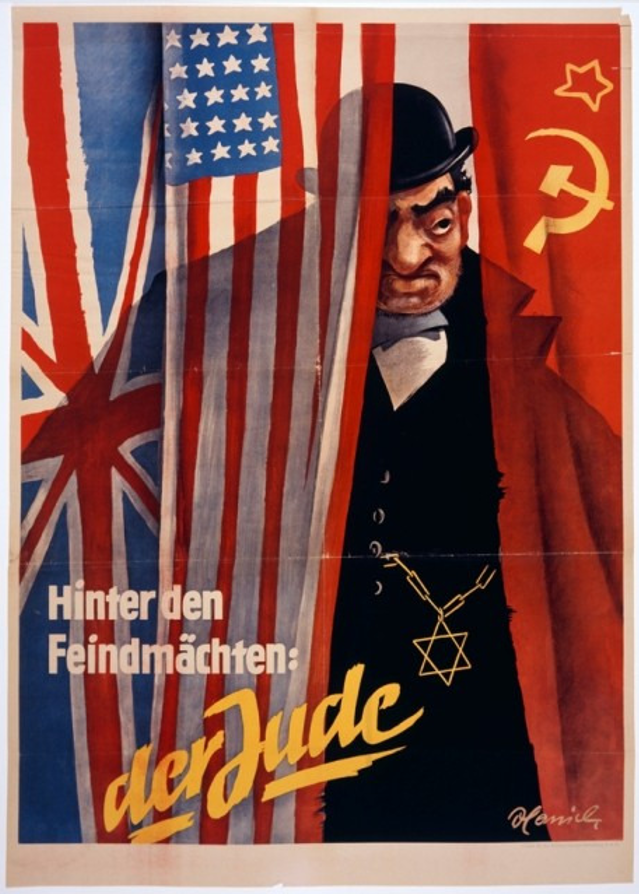
Looking at the two images, one can notice how Nazi caricature operated on different scales to construct the Jewish enemy. Die Juden in USA presents a seemingly individual, 'realistic' figure - a man in elegant clothing eating in a disgraceful manner - and localises the threat in a specific place - the USA, thus evoking the stereotype of the Jewish person as an opportunist who enjoys plentitude while the Germans must sacrifice. In contrast, Hinter den Feindmächten: der Jude is a rather abstract depiction of a silhouette with its face half-covered behind the three ideologically opposed flags, thus alluding to the idea that the Jew is not just one person in one country (eating greedily, as in the previous picture), but rather a single, powerful force behind all of Germany's enemies on the front. While the first image appeals to everyday resentment from the German population who suffers themselves, through the motif of food, comfort and abundance, the second caricature constructs a geopolitical narrative, where the Jew has the powers of the entire globe like a puppeteer.
Looking at one of their most important similarities, they both simplify complex ideas into instantly recognisable depictions, but their differences show a dual strategy: it personalises the enemy as a recognisable person in the first image, and it universalizes him as a shadowy power in the second caricature, so that the Jewish people appear both as concrete individuals (thus relating to the ordinary German citizen), but also as an omnipresent, malefic threat that must be eradicated.
2. Children's Books: Normalising the Enemy Image
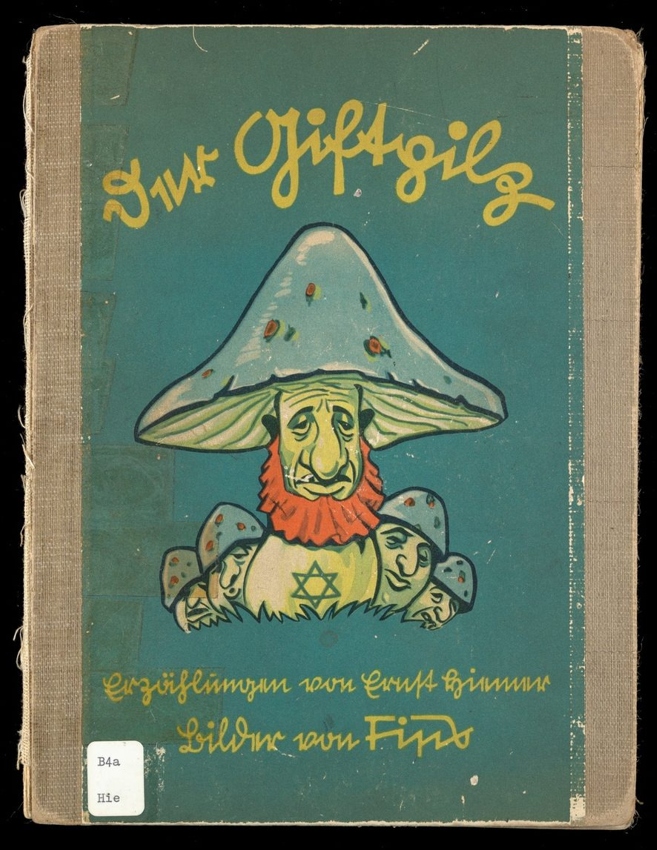
While adult-oriented caricatures including Die Juden in USA and Hinter den Feindmächten: der Jude used shocking visual simplification to provoke immediate emotional response against the Jewish enemy, Nazi propaganda also targeted the new generations through illustrated children's books which normalised and internalised antisemitic stereotypes as everyday knowledge and common sense. Der Giftpilz (The Poisonous Mushroom, 1938), written by Ernest Hiemer and published by Julius Streicher (the founder and publisher of the infamous antisemitic newspaper Der Stürmer) exemplifies this idea: through fairy-tale style stories and colorful illustrations, it taught German children to recognise and fear Jews instinctively, as a danger camouflaged within society of which they must be afraid and cautious. Rather than relying on wartime urgency, such images worked through repetition and moral instruction, using the same visual codes of greed, conspiracy and physical distortion into the worldview of the next generations.
The cover photo of Der Giftpilz establishes the book's central theme immediately: Jews as poisonous mushrooms that look harmless on the outside, but are actually lethal. A large, bearded 'mushroom' with a hooked nose and a Star of David portrays a Jew who looks menacingly, surrounded by similar fungi, which, shown in bright, fairy-tale-like colours, disguise the propaganda message as child-friendly entertainment.
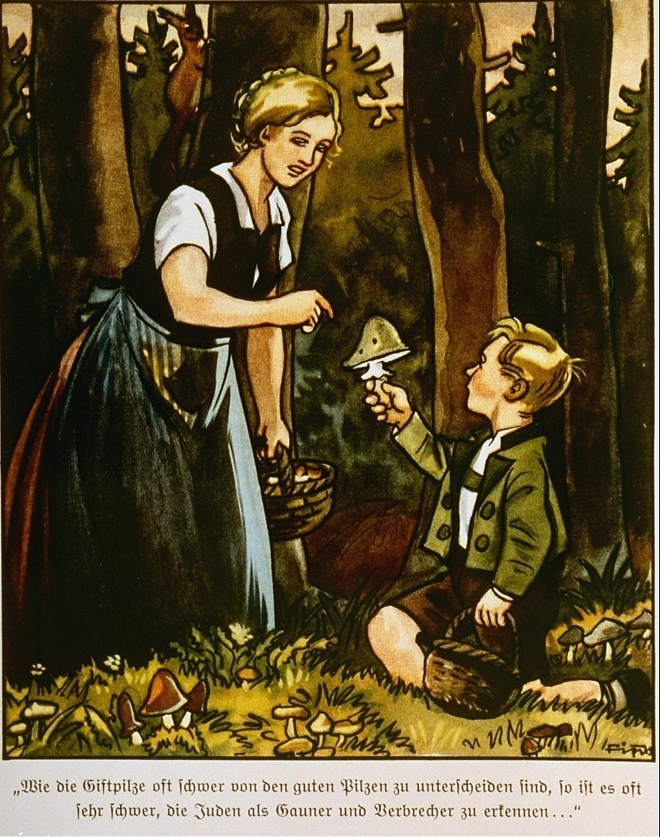
A core illustration from the book shows a German mother teaching her son in the forest to distinguish poisonous from edible mushrooms, with the caption below stating: 'Just as it is often very difficult to tell the poisonous from the edible mushrooms, it is often very difficult to recognize Jews as thieves and criminals...' The pale mushroom the child holds out shows the hidden nature of the Jewish enemy - apparently harmless but deceptive, a threat that even on its own it can cause damage and potentially death. Unlike the caricatures aimed at adults, this image uses a highly familiar, parental lesson and experience from the day-to-day life of a child being taught by their parent(s) as everyday caution towards Jews, training children to spot Jews as threats in their very own environment.
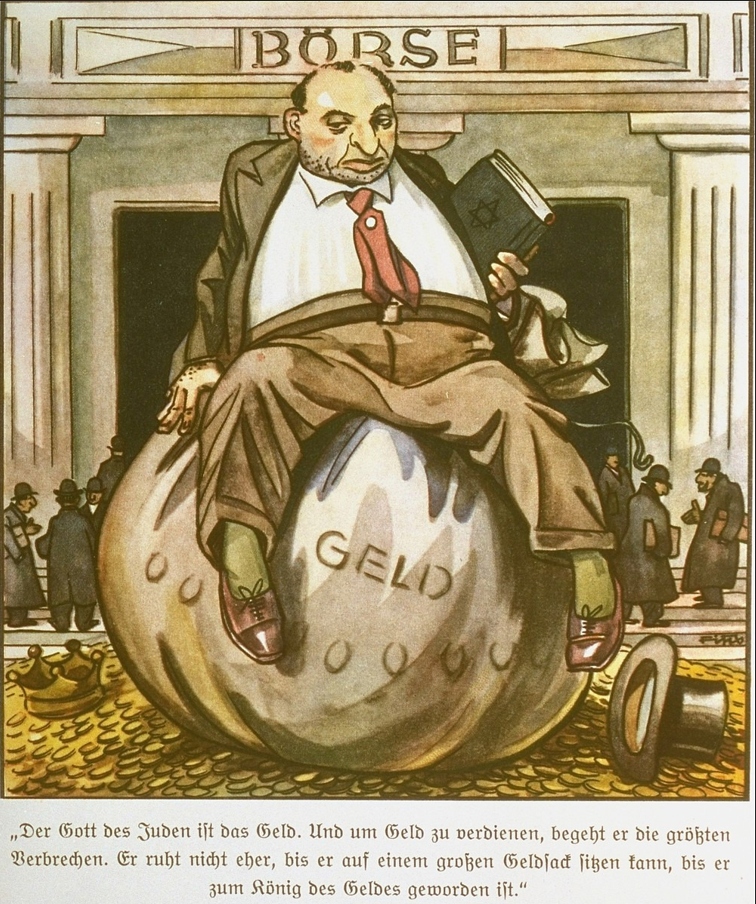
Another page from Der Giftpilz shows the stereotype of the greedy Jew with a fat man sitting on top of a giant sack which has the word 'Geld' written on it, holding a book in his hand with a Star of David on the hard cover. The caption under the picture states: 'Money is the god of the Jews. He commits the greatest crimes to earn money. He won't rest until he can sit on a great sack of money, until he has become king of money.' The exaggerated proportions (columns behind him and the sack of money itself) alludes to the fact that the Jews are opportunists who steal wealth belonging to the German, that they thrive making money and once they have made money and are depriving the Germans of their means to subsist - they are wealthy at the expense of the Germans struggling in their day-to-day life.
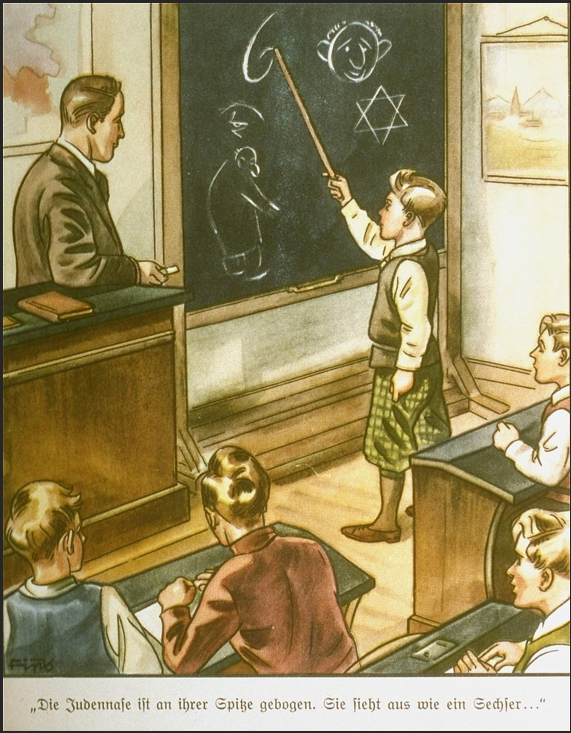
Der Giftpilz also teaches racial identification through a classroom scene where a student points to a blackboard drawing of the digit six which stands just above a depiction of a Jewish person with a full-body image, a face 'portrait' of the same enemy and the Star of David, all while the teacher looks at him attentively and the students sit in the classroom. The caption states: 'The Jewish nose is crooked at its tip. It looks like the number six...' Presented as the ordinary school lesson, the image takes abstract racial theory and turns it into practice by teaching children how to spot the Jews in daily life and what marks to look for. By linking the nose stereotype with the Jewish symbol, the image reinforces the broader propaganda narrative of Jews as absolute enemies, thus making sure the newer generations internalise these visual markers as unquestioned truth and remain cautious and fearful at all times.
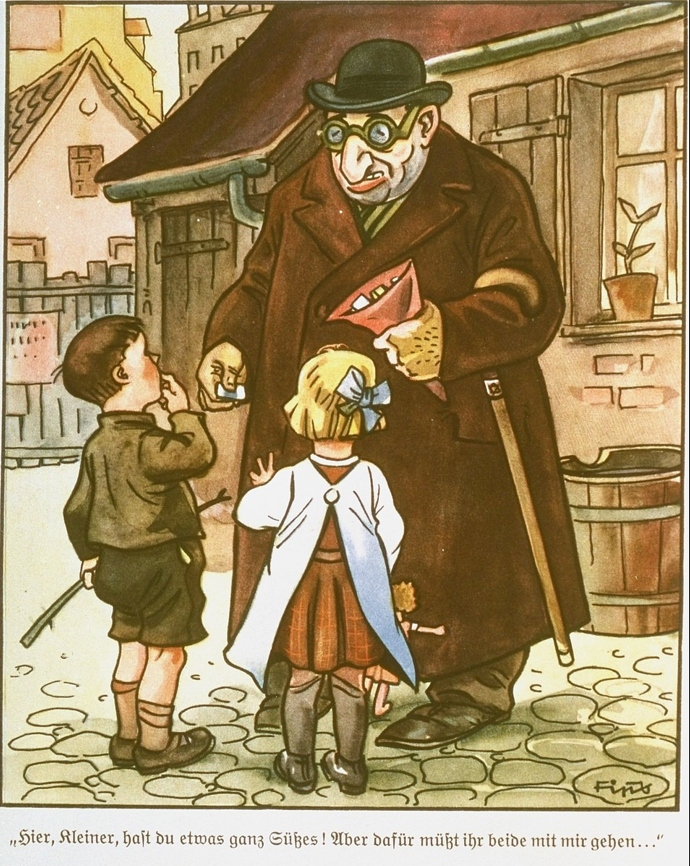
In the last image, the predatory nature of the Jewish enemy is shown in an illustration depicting a tall, sinister Jew dressed with a long coat and a hat offering candy to two Aryan children, while the caption says: 'Here, little ones, have some candy! But for that you will both have to come with me...' With an exaggerated nose, the figure embodies the dangerous child predator who uses deception to harm the German children and cause damage to the population and the next generations, training the innocent ones to see the Jews as a personal threat and to reject even 'friendly' advances.
Der Giftpilz constructed the Jewish enemy through four recurring themes across its illustrations: deception (Jews as camouflaged lethal mushrooms), greed (the Jew sitting on a sack of money), physical identification ('the six nose' and the Star of David) and predation (a Jewish predator). As Stout notes, referring to another children's textbook, 'Many young children reading this textbook in 1936 were young soldiers by 1944 and were fanatically loyal to the Führer. This structured indoctrination system allowed the Nazis to begin instilling their ideas in the German population at an early age so as to create a completely loyal and strong population that would always follow Hitler's ideals.' By presenting these as childhood lessons, the book effectively prepared entire generations to view the Jewish enemy as worthy of extermination when they later took up arms in total war.
3. Comparative Analysis: Adults and Children
While caricatures including Die Juden in USA and Hinter den Feindmächten: der Jude employed shocking imagery to provoke immediate emotional rejection of the Jewish during the war, children's books including Der Giftpilz used cheerful, colorful, fairy-tale illustrations to normalise the same ideas as everyday knowledge and common sense for children. Caricatures targeted adults with themes of greed and conspiracy, while the children's books taught practical identification skills and moral lessons using familiar settings, such as classrooms. This dual strategy employed by the Nazis ensured comprehensive enemy construction: caricatures generated urgent hatred during the war, while Der Giftpilz internalised instinctive prejudice in the children, thus creating a population to eventually perpetrate violence and terror against the enemy across generations.
4. Conclusion
To sum up, Nazi propaganda during World War II constructed the enemy primarily as a racial and ideological threat to the German population by reframing the narrative to show that it is a defensive struggle of the Volksgemeinschaft against a global world enemy. Through simplification, repetition, emotional appeal, caricatures made the enemy seem omnipresent, while children's books normalised the same ideas as moral lessons and common sense from early on. Propaganda hence legitimised exclusion and violence as acts of mere self-defence, thereby preparing the nation psychologically and morally for racial violence.
Bibliography
- A chart detailing physical characteristics of a Romani (Gypsy) individual (1983), Holocaust Encyclopedia <https://encyclopedia.ushmm.org/content/en/document/a-chart-detailing-physical-characteristics-of-a-romani-gypsy-individual> [accessed 15 January]
- Bartrop, R. Paul, 'Considering Nazi Propaganda as a Source for Studying the Holocaust' in Studying the Holocaust, 1st edn (Routledge, 2023), pp. 77-89 (p. 78), <https://doi-org.libproxy.ucl.ac.uk/10.4324/9781003248620>
- Hitler, Adolf, 'Chapter XI. Race and People' in Mein Kampf, trans. by James Murphy (2002), <https://gutenberg.net.au/ebooks02/0200601h.html#ch1-11>
- Kohl, Diane, 'The Presentation of "Self" and "Other" in Nazi Propaganda', Psychology and Society, 4 (1), 7-26 (11)
- Magazine, Die Juden in U.S.A., 1939, CSUN <https://digital-collections.csun.edu/digital/collection/InOurOwnBackyard/id/70/> [accessed 15 January]
- Narayanaswami, Karthik, 'Analysis of Nazi Propaganda: A Behavioural Study' (Harvard University) <https://hmh.org/wp-content/uploads/HIST-1572-Analysis-of-Nazi-Propaganda-KNarayanaswami.pdf> [accessed 16 January 2026]
- Stout, Michael J., 'The effectiveness of Nazi propaganda during World War II' (unpublished master's thesis, Eastern Michigan University, 2011), p. 21 <https://commons.emich.edu/cgi/viewcontent.cgi?article=1313&context=theses> [accessed 16 January 2026]
- Stephenson, Jill, 'Propaganda, Autarky and the German Housewife' in Nazi Propaganda, ed. by David Welch (Routledge, 2015), 117-142 (138)
- The German American Bund: A Pro-Nazi Organization in the United States, Holocaust Encyclopedia <https://encyclopedia.ushmm.org/content/en/article/german-american-bund> [accessed 15 January]
- Welch, David, 'Introduction' in Nazi Propaganda, ed. by David Welch (Routledge, 2015), 1-9 (2)